
AWARDS NEWS: Announcing the 2025 SHNH Natural History Book Prize shortlist (Thackray Medal)
We are delighted to announce the shortlist nominations for the SHNH Natural History Book Prize (John Thackray Medal), awarded for the best book published on the history or bibliography of natural history in the preceding two years.
We send our warmest congratulations to all authors and publishers Hans Walter Lack, James A. Compton & Martin W. Callmander (Muséum National d’Histoire Naturelle), L. C. (Kees) Rookmaaker (Brill), Régine Fabri (National Botanic Garden of Belgium), and Andrew Griebeler (University of Chicago Press).
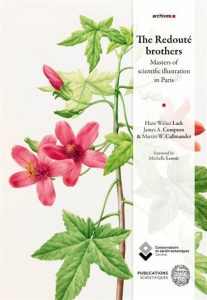 The Redouté brothers: masters of scientific illustration in Paris
Hans Walter Lack, James A. Compton & Martin W. Callmander
Muséum National d’Histoire Naturelle. 2024. 822pp. ISBN 9782383270201.
This work provides the first comprehensive biography of the three Redouté brothers, Antoine-Ferdinand, Pierre-Joseph and Henri-Joseph. Originating from humble origins in the Ardennes, they all took root in Paris where Antoine-Ferdinand became a decorative painter. By contrast Pierre-Joseph and Henri-Joseph embarked as botanical illustrators on a scientific and aesthetic career including numerous contributions to the prestigious royal paintings on vellum.
The central figure of this work is Pierre-Joseph, whose accurate illustrations document science during the late phase of the Enlightenment, throughout the turbulences of the French Revolution, the Napoleonic era and into the Restoration. Thus, PierreJoseph provided works for Empress Josephine and Queen Maria Amalia. An indefatigable worker, he produced an enormous number of botanical illustrations, many of a very high calibre. A large number of which were reproduced as engravings for a long list of publications which multiplied by many times the effect of his work.
His association with the new Muséum d’Histoire naturelle, but also notably with C.-L. L’Héritier and the Geneva botanist A.P. de Candolle, ensured successive commissions. HenriJoseph joined the scientific team that accompanied Napoleon’s Egyptian campaign, documenting plants, animals and artifacts. Although his output was more geared towards paintings of animals, he was frequently asked to contribute botanical works for Pierre-Joseph. In essence the focus of this book is not on the written record but on the pictorial. Furthermore it offers a panorama of the travellers, collectors, scientists, gardeners and illustrators in one of the great centres of the time – Paris.
See Alex George’s review in Archives of Natural History.
 The Vasculum or Botanical Collecting Box Symbol of the Nineteenth-Century Botanist, Now an Obsolete Relic
Régine Fabri. Translated by Henry J. Noltie
National Botanic Garden of Belgium. 2024. 269pp. ISBN 9783823618201.
Known as a botanical box, collecting box, or vasculum, this green or black tin box has accompanied generations of botanists and plant hunters for more than two centuries. It has housed myriads of specimens, some of which are still the pride of our great herbariums. A scientific device born in Europe at the dawn of the 18th century and recommended by Linnaeus, the vasculum quickly conquered the world. The boxes of the great names in botany that have been preserved to this day and the many portraits show the diversity of the models used.
An intriguing, even disturbing, piece of scientific equipment, the vasculum sometimes earned its owner suspicion of potato theft, poaching or smuggling, and even imprisonment. The herbarium box went on to appeal to a wide audience and became almost commonplace, as evidenced by the many illustrations and references to it in literature, notably by Jules Verne, Conan Doyle and Enid Blyton.
The green box also features prominently in the work of artists such as Carl Spitzweg and Raphaël Ritz. This volume, richly illustrated with photos, images and quotations, traces the history of this obsolete accessory – now exhibited in museums and much sought-after by collectors – from its strange origins to its obsolescence, via its hours of glory.
Read Isabelle Charmantier’s review in Archives of Natural History.
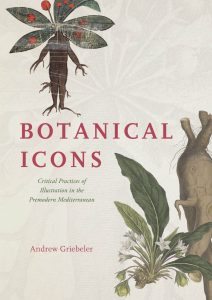 Botanical Icons:
Critical Practices of Illustration in the Premodern Mediterranean
Andrew Griebeler
University of Chicago Press. 2024. 344pp. ISBN 978022682679.
A richly illustrated account of how premodern botanical illustrations document evolving knowledge about plants and the ways they were studied in the past.
This book traces the history of botanical illustration in the Mediterranean from antiquity to the early modern period. By examining Greek, Latin, and Arabic botanical inquiry in this early era, Andrew Griebeler shows how diverse and sophisticated modes of plant depiction emerged and ultimately gave rise to practices now recognized as central to modern botanical illustration. The author draws on centuries of remarkable and varied documentation from across Europe and the Mediterranean.
Lavishly illustrated, Botanical Icons marshals ample evidence for a dynamic and critical tradition of botanical inquiry and nature observation in the late antique and medieval Mediterranean. The author reveals that many of the critical practices characteristic of modern botanical illustrations began in premodern manuscript culture. Consequently, he demonstrates that the distinctions between pre- and early modern botanical illustration center more on the advent of print, the expansion of collections and documentation, and the narrowing of the range of accepted forms of illustration than on the invention of critical and observational practices exclusive to modernity.
Griebeler’s emphasis on continuity, intercultural collaboration, and the gradual transformation of Mediterranean traditions of critical botanical illustration persuasively counters previously prevalent narratives of rupture and Western European exceptionalism in the histories of art and science.
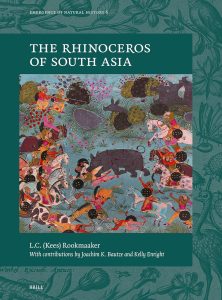 The Rhinoceros of South Asia
L. C. (Kees) Rookmaaker
Brill Imprint. 2024. 836pp. ISBN 9789004544888.
The rhinoceros is an iconic animal. Three species once inhabited South Asia, two of which disappeared over a century ago. This survey aims to reconstruct the historical distribution of these large mammals resulting in new maps showing the extent of their occurrences. Thousands of sources varied in time and nature are used to study the interactions between man and rhinoceros. The text is supported by over 700 illustrations and 38 maps showing the importance of the rhinoceros in the scientific and cultural fabric of Asia and beyond.
See Andrew C. Kitchener’s review in Archives of Natural History.